See You at the Pole and the Distortion of American Civil Religion
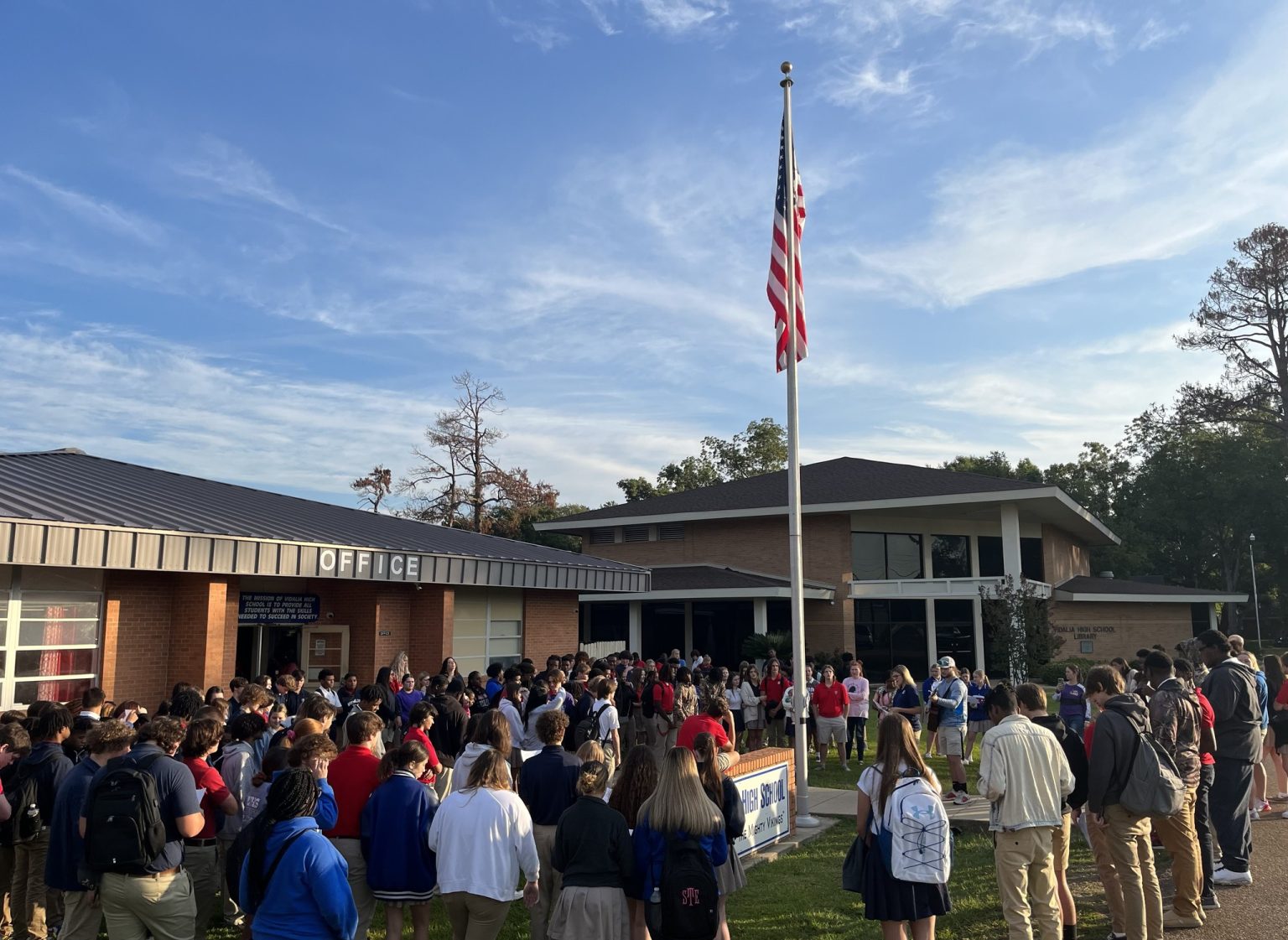
The photo I’ve provided is one taken at my high school, Vidalia High School, a small public school of about 400 students in Vidalia, Louisiana. You can see a group of students, and even some teachers, standing around the flag-pole in front of the school. Students are wearing clothes that fit into the uniform-esq dresscode, polo-shirts in school colors, and navy or khaki bottoms that's common for many schools in the Deep South. It’s morning, a clear fall day, and students’ heads are bowed in prayer. If you look closely, there’s also two students leading everyone in prayer, one holding a piece of paper, and another playing the guitar.
This photo is showing students participating in a phenomenon called See You at the Pole (SYATP). SYATP is, “...a global movement of prayer which is student-initiated, student-organized, and student-led. It revolves around students praying together on the fourth Wednesday in September, usually before school and usually at the school's flag pole (SYATP’s website).” Founded in the 1990s by a youth-group in Texas, SYATP is supposed to promote ecumenical prayer about the health of a country in obedience to a Bible passage, 1 Timothy 2:1-2. This verse states, “First of all, then, I urge that supplications, prayers, intercessions, and thanksgivings be made for all men, for kings and all who are in high positions, that we may lead a quiet and peaceable life, godly and respectful in every way (Revised Standard Version Bible, 1952, 1 Timothy 2:1-2).”
However, SYATP seems to be a uniquely Christian Evangelical, the photo itself was distributed by a group called The Louisiana Baptist Message. Although SYATP claims that the flagpole is an easy place at virtually all schools for a group of students to meet, there’s something more to it.
SYATP uses the flag, or more specifically the flag pole, as a totem of their movement, which is a spin-off from the American civil religion. In Elementary Forms of Religious Life, Durkheim identifies totems as being one of two sorts of things. For participants of SYATP, they use this interpretation, “ …it is also the symbol of the determined society called the clan. It is the flag; it is the sign by which each clan distinguishes itself from the others, the visible mark of its personality, a mark borne by everything which is a part of the clan under any title whatsoever, men, beasts or things (Durkheim, 155).” In a way, SYATP takes this definition literally, and uses the flag as the symbol by which participants are designated to pray. This can then be seen as being a part of the American civil religion. According to Bellah, the God of American civil religion is “...actively involved in history, with a special concern for America (7).” When SYATP gathers for prayer, their purpose is to pray for the country, among other things. By this logic, the people gathered are praying for the God that will protect and fortify their nation, and those within it.
Despite this, SYATP is a representation of a distortion of the American civil religion that Bellah discusses in his essay, "Civil Religion in America," how certain people and movements use the American civil religion for their own purposes (14, 18-19), SYATP is a prime example of this. Much of SYATP’s promotional material claims that the event is just about praying, while at the same time many supporters of the event use a biblical verse quoted on the website, Joshua 6:16, to claim the movement is about a spiritual “conquest” over a public place for Christianity, furthering the perception of the movement as a display of Chirstian hegemony in America. The American civil religion at its core is supposed to be somewhat secular (Bellah, 7-8). Meanwhile, as mentioned earlier, SYATP seems to be a uniquely Christian Evangelical phenomenon. On top of that, the American civil religion is supposed to be inclusive of all, meanwhile SYATP almost seems like an exclusive thing because of the people who participate in it.
While See You at the Pole isn’t something that’s widely heard about, the distortions it makes within the American civil religion can be felt. Speaking from experience, I was not present when this photo was taken about three years ago. Why? Simply because my peers didn’t think that I was among the “in-group” of those who wanted to pray in front of the flag pole. My identity as a queer, Asian-American was able to shield me from this participation in this event, but this goes against what Durkheim and even Bellah say this form of religion is for. In Elementary Forms, Durkheim states, “To strengthen those sentiments which, if left to themselves, would soon weaken, it is sufficient to bring those who hold them together and to put them into closer and more active relations with one another (158).” Because of the exclusiveness of this event for many who were in similar positions as myself, I was excluded from the collective effervescence this event was supposed to foster. While SYATP is only a representation of a slight distortion, it can be a warning sign of larger distortions within the Christian-Evangelical movement, especially when implementing itself into the imagery of America, and politics itself.
Works Cited
Bellah, Robert. 1967. “Civil Religion in America.” Daedalus, (vol. 96, no. 1), pp. 1–21.
Durkheim, Émile. 2015. “Elementary Forms of Religious Life (1912)” Pp. 145-62 in Sociological Theory in the Classical Era, 3rd ed, edited by L.D. Edles and S. Applerouth. Los Angeles: Sage
“FAQ” SYATP. Retrieved March 27, 2026 https://syatp.com/pages/faq?srsltid=AfmBOop1blqSAprTV11ylm6Dzor4xr4wl83iyZUFQ6lV38jnopbriOV5
Revised Standard Version Bible. 1952. National Council of the Churches of Christ in the United States of America.
2023. “Students pour out to God during See You At The Pole.” The Louisiana Baptist Message. Retrieved March 27, 2026 https://www.baptistmessage.com/students-pour-out-to-god-during-33rd-see-you-at-the-pole/



Comments
Post a Comment